
Username:
Abstract
Study Sites
- University of Alberta
- University of the Eastern Piedemont
- University of Romania
Additional Resources
Realistic Modeling of Procedure and Visit Delays for Simulation
Manuela Verde
Francesco Della Corte
Jeffrey Micheal Franc
Objectives
Simulation modelling of Intensive Care and Emergency Department patient flow depends on accurate assumptions regarding procedural delays. Currently no standardized methods for modeling these time delays exists.
Methods
Time delays for common procedures such as central venous access, intubation, chest-tube placement, and various imaging studies were recorded for patients in the emergency departments and intensive care units at the University of Alberta Hospital and L'Ospedale Maggiore Della Carita by a trained observer.
Hypothesis
Test Statistic
Statistical Methods
H0: Mean procedure and visit delays are independant of operator and site
H1: Mean procedure and visit delays are operator or site dependant
F-test
Significance of site and operator was assessed using ANOVA. If procedure and visits times were found to be independant of site and operator, a linear regression was constructed to provide a predictive formula for use in department flow simulation.
Results
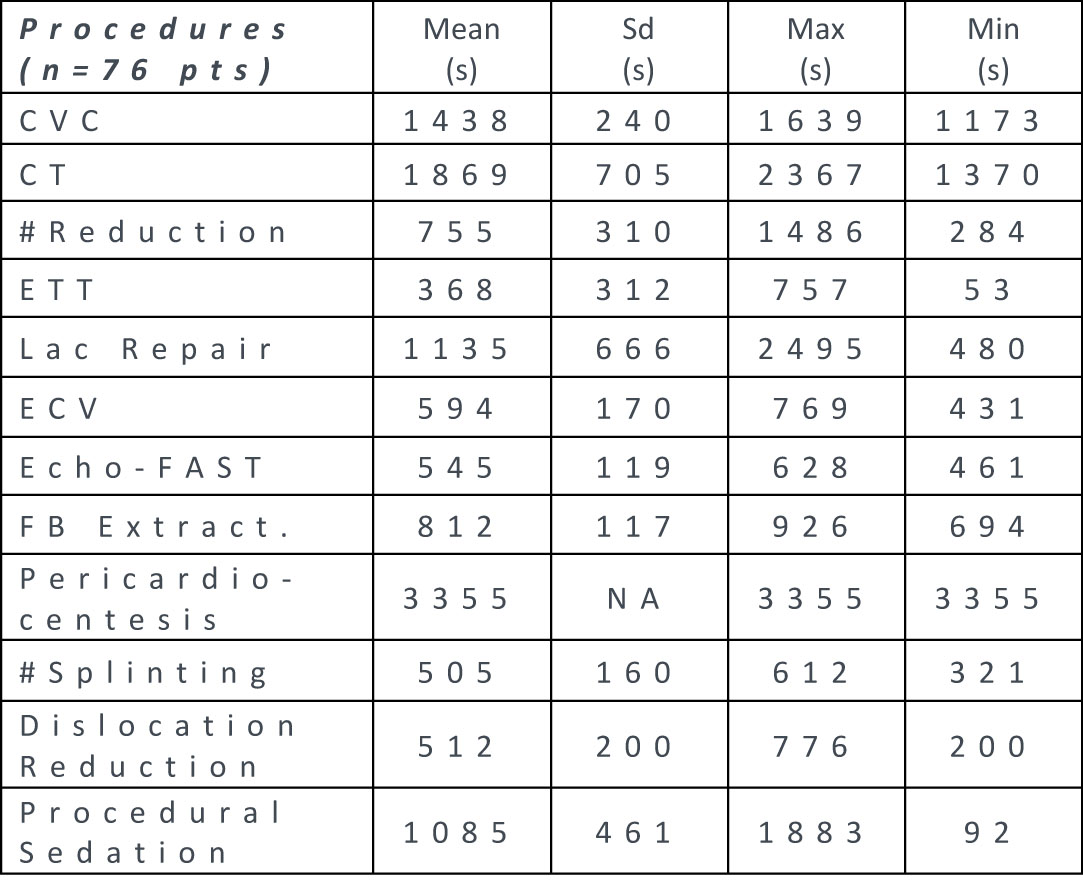
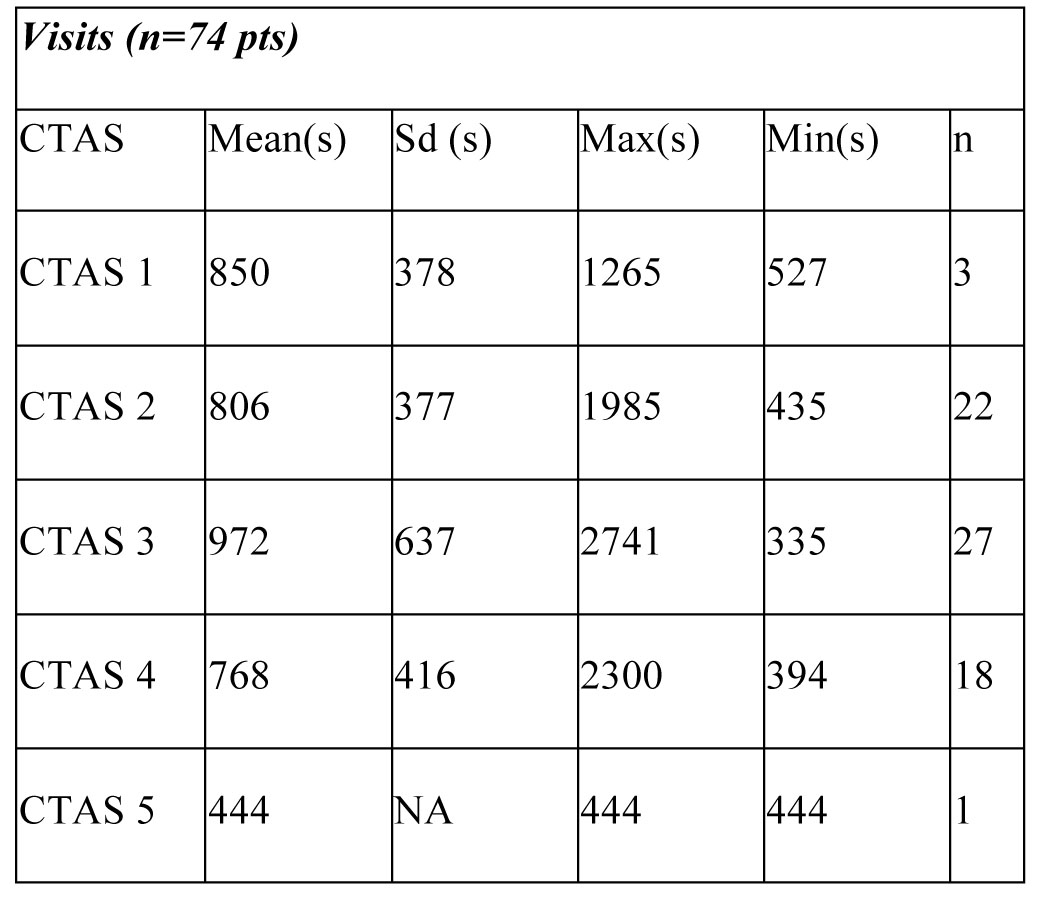
To date, 150 patient/physician encounters was recorded in the Emergency Departments at the University of Alberta Hospital, including forty-one different physicians. Data for twelve different procedures (76 encounters) was analyzed. Mean+/-SD in seconds for the five most relevant procedures included: central line (1438+/-240), chest-tube (1869+/-705), fracture reduction (755+/-310), intubation (368+/-312), and laceration repair (1135+/-666). Data for 74 visits was recorded, and categorized by the Canadian Triage and Acuity Scale (CTAS). Mean visit data +/- SD in seconds for the five CTAS levels was as follows: CTAS1 (850+/-378), CTAS2 (806+/-377), CTAS3 (972+/-637), CTAS4 (768+/-416), CTAS5 (444+/-NA). There was no significant relation between procedure or visit times and operator (p>0.3).
 |
|
Conclusions
Realistic estimates of time delays for common procedures and visits can be obtained through structured observation. In a large sample, standard deviations for procedures and vists are large, and are not predictibly related to operator.|
About Us |
|
|
|
|
|